

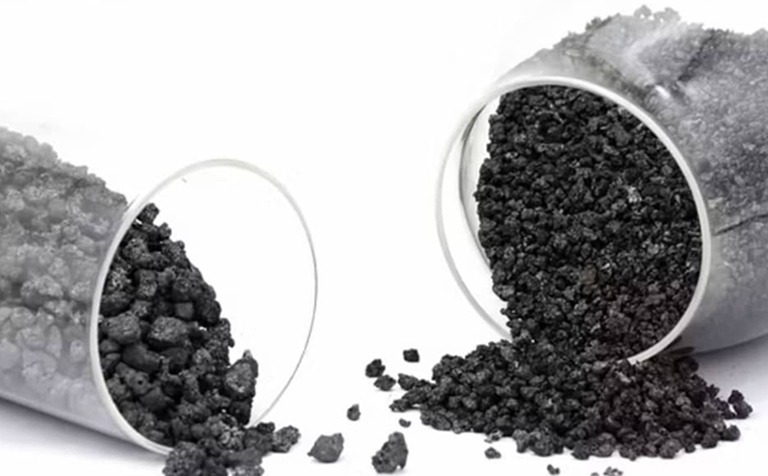
High-sulfur calcined petroleum coke (CPC-HS) is one of the raw materials used in the aluminum industry and, with its controlled chemical composition and suitable physical properties, offers optimal performance in anode manufacturing processes. In addition to having a high percentage of fixed carbon, this product has optimal purity and uniform structure, which makes it suitable for the production of carbon anodes.
One of the important features of CPC-HS suitable for aluminum is the controlled amounts of interfering elements such as vanadium, calcium, iron, silica and sodium; elements that, if exceeded, can reduce the efficiency of electrolysis cells and increase energy consumption. The precise control of these elements in CPC-HS makes this product fully compatible with the requirements of modern aluminum industries.
Also, the Air Reactivity and Carbon Reactivity indices in this type of coke are within a range that ensures optimal thermal resistance and carbon reactivity; as a result, the anode produced from this material has reliable and stable performance against oxidation and wear.
In general, high-sulfur calcined petroleum coke suitable for aluminum industries is considered a standard and approved option for its production in aluminum industries, with its optimal chemical composition, low amount of metal impurities, controlled reactivity, and appropriate calorific value.
Analysis of calcined petroleum coke used in the aluminum industry
| Technique | Standard Methods | Value | Unit | Typical | Index |
|---|---|---|---|---|---|
| Combustion | ISO 8005 | Max | % | 0.5 | Ash Content |
| Heating | ISO 11412 | Max | % | 0.2 | Moisture |
| Combustion | ISO 9406 | Max | % | 0.5 | Volatiles |
| Pyknometry | ASTM D5004 | g/cm³ | 0.05 ± 2.07 | True density | |
| g/cm³ | 0.85 | Bulk density | |||
| XRF-ICP | ISO 12980 | Max | % | 0.75 | Sulfur |
| XRF-ICP | ISO 12980 | Max | ppm | 100 | V |
| XRF-ICP | ISO 12980 | Max | ppm | 300 | Fe |
| XRF-ICP | ISO 12980 | Max | ppm | 200 | Si |
| ppm | 100 | Nickel | |||
| Sieving | ISO 12980 | Max | % | 30-45 | Particle Size > 6 mm |
| Sieving | ISO 12980 | Max | % | 20 | Particle Size < 1 mm |